Showing posts with label hind suspensory. Show all posts

Thursday, 23 February 2017

'Incurable' hind suspensories and Badminton beckons

ProJo finally able to use his natural power and athleticism

Purchasing ProJo as a four-year-old in 2010, Barbie Clarkson rode him twice before prolonged snow forced a lay off, but back into work, he was always a little inconsistent and so began a six year journey that was to encompass both the despair of a very poor prognosis and finally, the elation of qualification for the BE100 Misubishi Motors Cup at Badminton.
By ProSet, the eyecatching and athletic 17hh gelding ProJo is known as Joe and Barbie shares the ups and downs of their story in her own words...

Joe seemed always to be a little bit ‘on and off’, never nasty or difficult, but a bit nappy or grumpy, although we couldn’t work it out and thought perhaps that as a rising five-year-old coming back into work he was testing our patience. However he progressed to ‘planting’, so we started to think about pain, but still weren’t sure; was he just being a bit difficult? We thought about gastric ulcers and he was affected, so treated, after which we expected his behaviour to improve, which it did a little. So we got going and even did a little bit of eventing.
He was always happy to jump, but on the flat found it difficult to produce power. When he was six in 2013, we had started novice level eventing, were doing novice level dressage and had even done a few elementary tests, but he never progressed as expected and things ‘sneaked up’ on us over time.

It was the following year, in 2014, that we didn’t get a good start to the eventing season. I had planned that we’d do three BE100s, then go novice, but events were cancelled because of bad weather. Our first run ended up being novice level, at which the show jumping was on long, lush, wet grass and he said ‘no’ for the first time, resulting in us being eliminated.
We came home and two days later had a session with my dressage trainer. She eventually said - “he’s not sound behind”, but I couldn’t feel it. She said she’d watched him many times in training and had thought there was ‘something’ for a while, but couldn’t pinpoint it.

Our vets nerve blocked him and confirmed lameness in both hind legs. So he had around eight weeks off, because there was no obvious sign of anything wrong. At that time I really didn’t want to know my very lovely horse was lame and maybe would be written off like others before him!
The rest didn’t work and back in work, he was quite difficult, so we did a ‘bute test and he was fine, which confirmed a pain issue and the investigations became more serious. An MRI scan revealed a problem with his suspensory ligaments, high up in both hind legs, where the ligaments attached onto the hock, but without external swelling or heat. Conformation was not the reason, treatment options were limited and he ended up having the whole of his seven-year-old year off.

Veterinary options were shock wave treatment or surgery, but success was unlikely. We talked about ArcEquine as we’d got to the point where there were no other options, and started using an ArcEquine unit during a 10-week period of box rest.

Walking him out started at week two – initially for 10 minutes a day – but Joe was terrifying and eventually I started to ride my daughter’s pony and lead him on a chifney, which worked because whenever Joe misbehaved, the pony would bite him, which gave me control! We broadly followed the ArcEquine rehabilitation plan and built the walking up to 30 minutes daily before I got back on. He has benefited from use of the ArcEquine unit ever since and fortunately we have never looked back and not had another major injury.

The following season as an eight-year-old we did only flatwork and dressage, progressing massively at that point. He was hacked out at home and we were really careful and paranoid about everything to do with his limbs; he became a proper diva! When you’re on that ‘last chance’ kind of thing, it was all about keeping him properly fit, getting him to carry himself properly, whilst ensuring he was never overusing any particular structure in his body.
As a nine-year-old we progressed to doing 1 x BE90 to test whether he would be sound! He was very silly, loved his jumping and it told me he was still keen for the job and really happy. He was sound the next day and stayed sound.
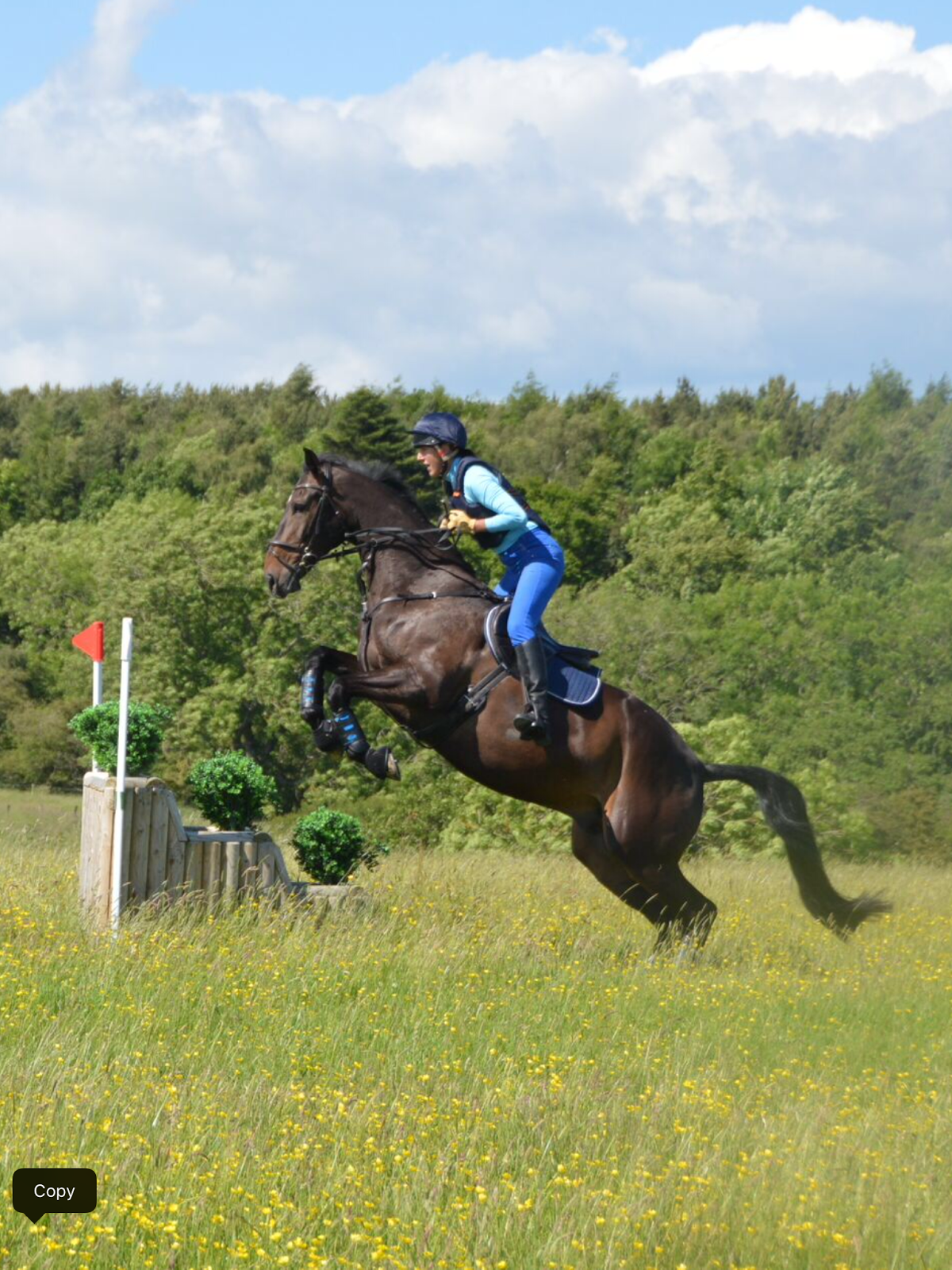
Confidently schooling over BE novice fences
It wasn’t until 2016 when Joe was 10 that I thought I would try out a little more, but not until I knew the ground was going to be OK.  I planned not to do many events, but following pre-season training with Blyth Tait, at which we ended up jumping 1.30m despite my slight lack of confidence, then a confident cross country session with Les Smith over novice fences, we decided to start at BE100. We finished fourth, so he was definitely back.

I was very careful all season, using iced boots to cool his ligaments along with the ArcEquine after every event and for maintenance each month. We had three novice runs and as I messed up, not him, we had no novice points and were still therefore eligible for the BE100 Misubishi Motors Cup Regional Final, which I entered.
That event was at Aske Hall and the ground was appalling. Jumping in ‘clart’ and slippery conditions is horrible and you just get to know over the years that there are too many things you can break in a horse for no reason and you don’t want to risk them. Fortunately, none of that happened and amazingly, we qualified for Badminton!

Our vets could do nothing for Joe, but have been supportive of my use of an ArcEquine unit and I do swear by it for his recovery. It would be interesting to re-do the MRI scan and see the ligaments now, as when I ride Joe he feels like a very, very different horse and he can use himself in a completely different way, producing power and hence able to work much better in every discipline.

Tuesday, 10 November 2015

Alfi's story is still unfolding .....

Alfi

When Holly Davies brought home an 11 month old pure bred chestnut arab called Alfi 12 years ago it marked the beginning of an often difficult journey, but her recent purchase of an ArcEquine microcurrent unit, has opened up the prospect of resolving the last of many different veterinary and management problems affecting Alfi over the years.

Holly has worked as an Animal Communicator and Therapist from her home base in South West Wales for 16 years and she specialises in horses, which account for 90% of her caseload. Most of her work is UK based, but around 10% involves telephone or email contact with international clients. Alongside this she is an enthusiastic author, having written no fewer than seven books in the last year along with college courses in Equine Energy Therapy and Animal Communication.

Her current book Arabian Recipe will be published early in 2016 and is about Alfi, who carries the sought-after Crabbit bloodlines. It chronicles his life and will include reference to the successful use of an ArcEquine microcurrent unit. Holly takes up the story.....

“When I first brought Alfi home, I was aware he had something of a parrot mouth and a rather odd hind leg action, but somehow I knew he was the horse for me. Straight away though, he had problems, starting with a ‘snotty nose’ virus from which it took him six months to recover.

“Other problems over the years included ongoing mud fever and persistent cellulitis and various often severe sensitivities and allergies. However despite all of this, he was backed when he was four, then turned away again for a year.

“He has also suffered from sarcoids and I remember one occasion a vet banded a sarcoid in his foreleg ‘arm pit’ and it rubbed, eventually causing a split in the skin. This developed a horrible infection in just two hours – and it took him three months to recover.

“Along the way, I discovered his current cranial therapist, a brilliant lady called Lucinda Munchhausen whose expertise has helped him enormously. Managing him was easier than it might have been, as I was working from home, but these experiences meant I started to work more in natural therapies, zoopharmacognosy* and remedial nutrition and I’ve used all of that knowledge to help Alfi.
“Earlier this year, when Alfi was fit and looking well, he came in from his nice flat paddock very lame and we discovered that he had somehow damaged a stifle joint quite badly. At one point we were near putting him to sleep as we didn’t expect him to recover, but we didn’t and happily, although it took many weeks, he did indeed recover. However he was only sound for two weeks then he suffered a puncture wound (and developed a splint) on the other hind leg, which led to an abscess that subsequently burst out along the coronet band. Between the two injuries, he had spent a lot of time standing on whichever was the sound hind leg and as a result, it emerged that he had seriously damaged both hind fetlocks.

Alfi's worst hind fetlock on Oct 10th
“When the equine vet scanned him, his near hind had suspensory damage and a thickened annular ligament which measured 5.5mm rather than the normal 3-4mm. The off hind also had suspensory damage, along with an annular ligament over three times the normal thickness at 11mm and a tear in the deep digital flexor tendon. The vet basically told me that his only chance was to have the worst annular ligament cut.....

“I was very upset, but the next day, having decided that after 12 years, that wouldn’t be kind to him, I started researching other options. Although I work in lots of different therapies and have researched more, I looked in depth at the ArcEquine and sent a link over to Lucinda, who told me she had a unit and would get one sent to me. It arrived in two days and since then – five weeks now – he’s worn it for 10-14 hours every day.

Improvement - the same fetlock on Oct 20th

“We saw dramatic changes in the worst fetlock in just 17 days and he came sound again, but it is still distended and we are now waiting for his next scan, which we hope will show that repair is going on ‘inside’ the tissues. He’s also on nutritional support to facilitate cellular repair, including amino acids and vitamins C and E. I was told to either box rest or yard rest him whilst still ensuring he used both legs evenly, so as he’s incredibly sensible, my version of that is to turn him out in the yard or a small paddock so he is wandering, not standing still and resting one of his hind legs.

More improvement by Oct 27th

“Lucinda is thrilled with his improvement and his usual vet has described the images as ‘pretty impressive’. How much repair we’ll end up seeing I don’t know, but we are only five weeks in, so expectations are high and the equine vet says that even if there’s a marginal improvement that we’re on the right route.

“I love the ArcEquine, as the programmes run for several hours, so there’s no need to frequently re-set it. It’s so simple to use and the straps and unit are very straightforward to put on. With a boot over it for protection, I just pop it on and leave him to wander.”

Alfi is one of three Arabs Holly owns and like his grey half brother Harree, she describes him as a “gentle, sweet horse”. Her third arab is an eyecatching black horse called Manta.

Holly concludes: “All of the horses I’ve taken on to date have had some sort of a problem and I wanted my perfect horse, so I went looking – and found Alfi! As it turned out, he is the perfect horse for me as I’ve learnt so much and if it wasn’t for him, I would not have done the research and learnt all the things I now use with other people’s horses. His story has provided not just content for books, but also strategies I now use for working successfully with other horses.

“I am waiting to see how much healing we get - and it would be wonderful to see my granddaughter, who is eight, able to ride him around the fields again without tack.”

*pharmacognosy - the study of medicinal drugs derived from plants or other natural sources.